ZENPORT Overhauls Its AI Agent “ZenMapping” for ERP Integration — Shifting Data Mapping from “Inference” to “Derivation”
ERP integration across organizations and processes: set up immediately, kept up to date
Tokyo, Japan — September [DD], 2026 — Zenport Inc. (Head Office: Chiyoda-ku, Tokyo; CEO: Fumiyuki Ota) has fully overhauled ZenMapping, the AI agent that builds the data integrations between ZENPORT—the data hub that brings all of a company’s global supply chain data together in one place—and customers’ ERP systems and master data. The overhauled ZenMapping has been available since August 12, 2026.
In the overhauled ZenMapping, AI analyzes the structure of master data, and mappings are derived from a confirmed semantic model. This substantially reduces the time people spend creating and verifying mappings.
As a result, data integrations with ERP systems and master data—which used to take a great deal of time—can be set up immediately. When master data changes, mappings can be updated promptly and kept current. Results do not depend on who does the work or when it is done, and the basis for each decision is kept on record.
ZENPORT calls this approach “Derivation” (導出).
■ The Enterprise AI Paradox — Humans Verifying Every AI Output
Mapping master data that follows a different scheme for every trading partner, and integrating it with ERP systems, has long depended on manual work at most companies. AI-based automation has spread in recent years, but because most of it rests on probabilistic inference, three problems have remained:
- People must verify every result for correctness.
- When master data is updated, the outcome may differ from the previous run.
- When staff change or an error occurs, there is no way to trace afterward why a result came out as it did.
AI was supposed to take the work off people’s hands. Instead, it handed back a new job: verification. This inversion has held back AI adoption in ERP integration.
■ What’s New — Not Inference, but Derivation from a Confirmed Semantic Model
In the overhauled ZenMapping, AI automatically analyzes the structure of master data. Mappings are then derived uniquely from a confirmed semantic model (ontology).
AI is used to analyze the data structure. Everything from there on—the derivation itself—is carried out mechanically from the confirmed semantic model, so the same input always produces the same result.
This approach gives ZenMapping the following properties:
- Fast to build, fast to update: Because AI handles everything from analysis through derivation, integrations can be set up immediately and updated promptly when master data changes. Human checking is substantially reduced.
- Reproducibility: Given the same master data, the same mapping is reached—regardless of who builds it or when.
- Traceability: The basis for each derivation is kept on record, so causes can be pinpointed and decisions handed over.
- No changes on the customer side: Customers’ master data is never altered. AI analyzes the differing data formats and structures of each trading partner and converts them to fit the customer’s own definitions.
Customers can verify these properties in a pre-implementation proof of concept (PoC), using their own master data in their own environment.
■ Connecting to ZenRead — ZenMapping Prepares the Data to Reconcile Against
One effect of this overhaul is the connection to ZenRead.
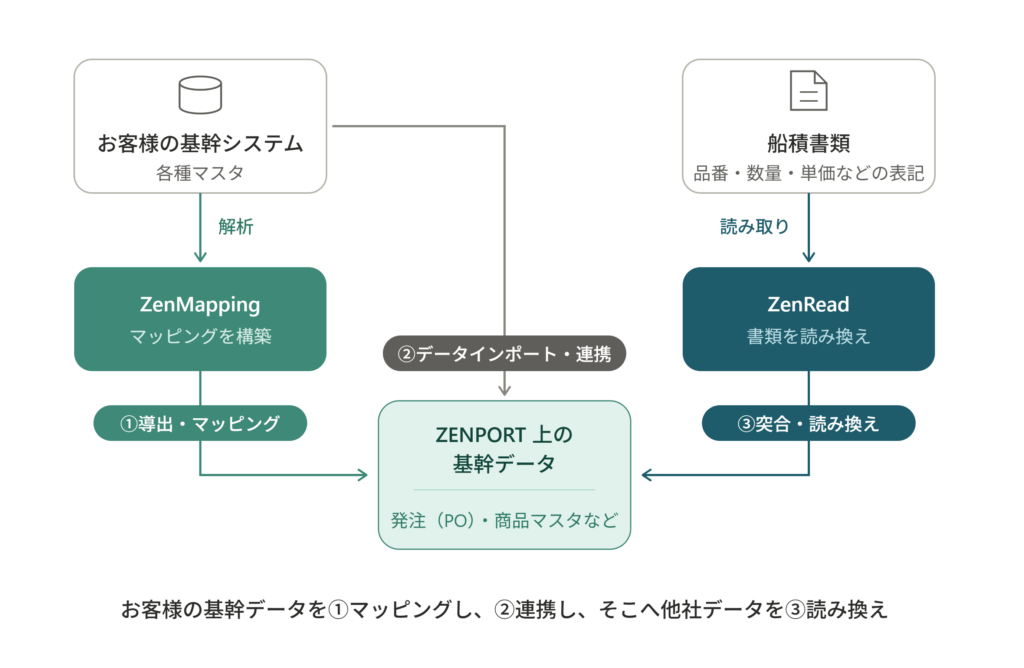
ZenMapping analyzes the master data structure of the customer’s ERP system, derives the mappings, and links them (Figure 1). Through these mappings, ZENPORT syncs the customer’s ERP data, such as purchase orders (POs) and the item master (Figure 2).
ZenRead is the AI agent that translates shipping documents into ERP data. It matches what it reads against contextual data—the ERP data held in ZENPORT—and translates the descriptions on each document into the customer’s items and the matching lines of its purchase orders (Figure 3). (See the August 10, 2026 release on this enhancement: [link to the English ZenRead release].)
With this overhaul, accurate mappings are derived in far less time, supporting ZenRead’s translation work.
■ How People and AI Share the Work
In the overhauled ZenMapping, people go only as far as approving the meaning; AI handles the implementation of the mappings. The authority to decide what counts as correct always stays with the customer, and AI adapts to that decision.
Customer data is not shared with other companies, and Zenport does not use it to train models. Mappings are kept separate for each customer, so one customer’s data never affects another’s results.
Guided by the principle of Human in the Loop, ZENPORT supports better operations and management through collaboration between technology and people.
■ Implementation
ZenMapping can be implemented on top of each trading partner’s existing workflows and document formats and the customer’s existing ERP systems. Because it works from data that already exists, it adds no new manual entry as a rule.
Data that customers enter or sync into the service, and the results it generates, are managed so that no other customer can view or use them. The service uses generative AI services under contracts and settings that prevent this data from being used to train or improve shared AI models. Zenport does not use this data to train models either, unless the customer explicitly consents or instructs otherwise.
■ Putting “Fit to Ontology” into Practice
This overhaul is a product implementation of “Fit to Ontology,” the approach ZENPORT proposes:
An approach that moves the target of standardization from the layer of operations and systems to the layer of meaning, and hands the role of fitting to the standard from humans to AI. Here, it is AI, not humans, that performs the Fit. The AI that fits, not the human.
For the definition, see https://zenport.io/fit-to-ontology/ (Japanese). The original article is also available in English: https://medium.com/@fumiyuki.ota/from-fit-to-standard-to-fit-to-ontology-ai-s-new-equilibrium-in-enterprise-tech-8d86ad3e02f5
■ About ZENPORT — A World Where Cognitive Diversity Creates Prosperity and Innovation
ZENPORT envisions a world where global data, people, and economies are seamlessly connected, enabling sustainable prosperity and innovation through cognitive diversity.
Under this vision, Zenport provides a data foundation that lets customers connect across organizations without asking their partners to change: ZenRead, which connects trade documents to operational data, and ZenMapping, which connects data to ERP systems and master data reproducibly and traceably.
■ Company Overview
・Company name: Zenport Inc.
・Address: GranTokyo South Tower 11F, 1-9-2 Marunouchi, Chiyoda-ku, Tokyo 100-6611, Japan
・Representative: Fumiyuki Ota, CEO
・Vision: “A world where differences become strengths.”
・Mission: “Connecting data across organizations and processes to accelerate business.”
・Business: Development and provision of an AI-native ontology platform for global supply chains. Proponent of “Fit to Ontology.”
・URL: https://zenport.io
■ Media Contact
Zenport Inc., Public Relations — info@zenport.io