
Answers based on ZENPORT’s official manuals, in Japanese or English
Tokyo, Japan — [October 20], 2026 — Zenport Inc. (Head Office: 1-9-2 Marunouchi, Chiyoda-ku, Tokyo; CEO: Fumiyuki Ota; “Zenport”) has added “AskZENPORT,” an AI support chat for questions about how to use ZENPORT and what the fields on its screens mean, to ZENPORT, the global supply chain data hub. AskZENPORT is now available.
AskZENPORT opens from the bottom-right corner of the ZENPORT screen. Users type a question while logged in to ZENPORT, and AI answers based on ZENPORT’s official manuals. AskZENPORT supports both Japanese and English.
■ Background
ZENPORT brings together global supply chain data—orders, shipments, containers—across companies in different roles, such as importers, exporters, freight forwarders, and warehouses. To support a wide range of use cases, its screen fields are defined down to the details of the work: a single date, for example, can carry an initial plan, revisions, and an actual result.
Until now, users who were unsure how to do something or wanted to confirm what a field meant had two options: consult the manuals or contact ZENPORT support. Time spent searching or waiting for an answer stops the work at hand, and users had asked for a way to check on the spot, within the screen.
■ What AskZENPORT Offers
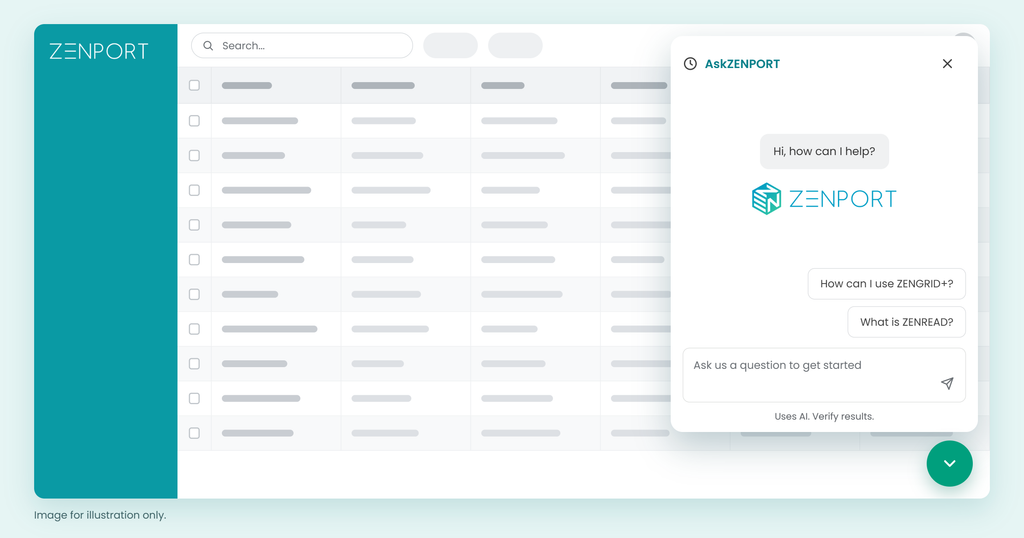
1. Accessible from the bottom-right corner, at any time
AskZENPORT opens from a button at the bottom right of any ZENPORT screen. It remains accessible even while a detail panel is open alongside, so users can ask questions without interrupting their work.
2. Guidance on navigating ZENPORT and field definitions
AskZENPORT answers questions such as “How do I create a shipment?” or “What does this date refer to?”
3. In Japanese or English
Because AskZENPORT supports both Japanese and English, staff at overseas sites and at overseas trading partners can use the same chat.
AskZENPORT may not be able to answer questions on matters the official manuals do not cover.
■ Company Overview
Company name: Zenport Inc.
Address: GranTokyo South Tower 11F, 1-9-2 Marunouchi, Chiyoda-ku, Tokyo 100-6611, Japan
Representative: Fumiyuki Ota, CEO
Business: Development and provision of an AI-native ontology platform for global supply chains (ZenRead, ZenMapping, Zentology). Under the banner “Connect without asking partners to change,” Zenport is the proponent of “Fit to Ontology”—“Here, it is AI, not humans, that performs the Fit.” The AI that fits, not the human.
URL: https://zenport.io
■ Media Contact
Zenport Inc., Public Relations — https://zenport.io/contact/
Matching product details and transaction history to translate each partner’s differently coded item names into the customer’s own items
Tokyo, Japan — September [DD], 2026 — Zenport Inc. (Head Office: Chiyoda-ku, Tokyo; CEO: Fumiyuki Ota; “Zenport”) has strengthened the judgment capability of ZenRead—its AI agent that reads shipping documents and translates them into the definitions used in the customer’s ERP data—through enhanced contextual data matching. The enhancement has been available since August 10, 2026.
ZenRead matches the details written on a document—trading partner, quantities, unit prices, and the like—against the transaction history with each partner held in the customer’s synced ERP data: the data that shows the context of the transaction. On this basis, it translates item names written in each partner’s own scheme into the customer’s items, ties each one to the matching line on the corresponding purchase order (PO), and determines exactly which line of which PO the document is for.
■ Background — Beyond OCR: The Heavy Work of Judging What Has Been Read
In global supply chain operations, the product names on commercial invoices and other shipping documents arrive in a different format and wording from every trading partner. With AI-OCR now widespread, the step of reading the text has largely been automated. But judging which of the company’s own items a reading corresponds to, and which line of which PO the document is for, still rests on the experience and manual work of the people in charge. The further reading and digitization advance, the more the step that follows—reconciling to the company’s items and purchase orders—stands out as the heavy manual work left after reading.
■ Where ZenRead Stands
The standard Zenport sets for document AI is not only that it can read text. It is that what has been read is connected all the way through: to which of the customer’s items it is, and to which line of which PO it belongs.
Starting from the moment a document arrives, ZenRead carries the work through in a single flow, from identifying the item to reconciling it against the purchase order, line by line. It does not do away with judgment. It leaves human confirmation to the cases that need it—and that alone takes most of the burden out of the work.
ZenRead started as an AI-BPO service and has since automated more and more of this judgment. Today it runs as an AI agent, executing everything from reading to reconciliation in one flow.
It asks for no changes—not to trading partners’ document formats, and not to the customer’s ERP systems.
■ Key Features
1. Item identification through contextual data matching
ZenRead identifies which item in the customer’s item master a product written on a shipping document corresponds to. It does not use probabilistic scores to make that judgment. It matches the details on the document—trading partner, quantities, unit prices, and the like—against the transaction history with each partner in the synced ERP data, and identifies the item within the context of that transaction.
In this way, item names written in each partner’s own scheme are translated into the customer’s items.
2. Line-by-line reconciliation with purchase orders
ZenRead ties each document to the specific purchase order, and the specific line on it, that the document is for. From the moment a document arrives, it updates which PO quantities are in transit and which order balances remain open. Even with corrections, split shipments, or transactions that span several documents, it keeps each document tied to the right line of the purchase order.
[Figure 1: English version of the published three-column comparison]
Note: Line-by-line reconciliation with purchase orders is available when PO data is synced.
3. People step in only where confirmation is needed
Reading a document and making the business judgment are two different jobs. In ZenRead, AI carries the work through in one flow—reading, identifying the item, and reconciling it against the purchase order. People confirm only what needs confirming.
Rather than leaving AI-OCR output as raw text, ZenRead connects it to the company’s items and to the right lines of its purchase orders, and carries it forward to a business judgment. This is the Human in the Loop design ZenRead has held to since launch.
■ In Practice — Knowing What Is in Transit
Inventory that has been shipped but not yet received—goods in transit—cannot be physically counted, and the evidence for its quantities and breakdown is scattered across documents from each trading partner. With ZenRead’s reconciliation, customers know which items are in transit and in what quantities, line by line against each purchase order, from the moment the documents arrive. In-transit inventory is captured from the shipping documents already handled in daily import and export work—and the records needed to keep a ledger build up as part of the workflow itself.
■ Implementation
ZenRead can be implemented on top of each trading partner’s existing workflows and document formats and the customer’s existing ERP systems. Because it works from data that already exists, it adds no new manual entry as a rule.
Data that customers enter or sync into the service, and the results it generates, are managed so that no other customer can view or use them. The service uses generative AI services under contracts and settings that prevent this data from being used to train or improve shared AI models. Zenport does not use this data to train models either, unless the customer explicitly consents or instructs otherwise.
■ Related Information
One Grid Journal, “Reconciling In-Transit Inventory Line by Line Against Purchase Orders” (Japanese): https://note.com/fumiyuki_ota/n/n6398524ec87a
Taking an importer’s in-transit inventory as its example, the article explains from an accounting and audit perspective why reconciliation must happen at the level of each line on the purchase order, not the document.
■ About ZENPORT — A World Where Cognitive Diversity Creates Prosperity and Innovation
ZENPORT envisions a world where global data, people, and economies are seamlessly connected, enabling sustainable prosperity and innovation through cognitive diversity.
Under this vision, Zenport provides a data foundation that lets customers connect across organizations without asking their partners to change: ZenRead, which connects trade documents to operational data, and ZenMapping, which connects data to ERP systems and master data reproducibly and traceably.
■ Company Overview
・Company name: Zenport Inc.
・Address: GranTokyo South Tower 11F, 1-9-2 Marunouchi, Chiyoda-ku, Tokyo 100-6611, Japan
・Representative: Fumiyuki Ota, CEO
・Vision: “A world where differences become strengths.”
・Mission: “Connecting data across organizations and processes to accelerate business.”
・Business: Development and provision of an AI-native ontology platform for global supply chains. Proponent of “Fit to Ontology.”
・URL: https://zenport.io
■ Media Contact
Zenport Inc., Public Relations — info@zenport.io
ERP integration across organizations and processes: set up immediately, kept up to date
Tokyo, Japan — September [DD], 2026 — Zenport Inc. (Head Office: Chiyoda-ku, Tokyo; CEO: Fumiyuki Ota) has fully overhauled ZenMapping, the AI agent that builds the data integrations between ZENPORT—the data hub that brings all of a company’s global supply chain data together in one place—and customers’ ERP systems and master data. The overhauled ZenMapping has been available since August 12, 2026.
In the overhauled ZenMapping, AI analyzes the structure of master data, and mappings are derived from a confirmed semantic model. This substantially reduces the time people spend creating and verifying mappings.
As a result, data integrations with ERP systems and master data—which used to take a great deal of time—can be set up immediately. When master data changes, mappings can be updated promptly and kept current. Results do not depend on who does the work or when it is done, and the basis for each decision is kept on record.
ZENPORT calls this approach “Derivation” (導出).
■ The Enterprise AI Paradox — Humans Verifying Every AI Output
Mapping master data that follows a different scheme for every trading partner, and integrating it with ERP systems, has long depended on manual work at most companies. AI-based automation has spread in recent years, but because most of it rests on probabilistic inference, three problems have remained:
- People must verify every result for correctness.
- When master data is updated, the outcome may differ from the previous run.
- When staff change or an error occurs, there is no way to trace afterward why a result came out as it did.
AI was supposed to take the work off people’s hands. Instead, it handed back a new job: verification. This inversion has held back AI adoption in ERP integration.
■ What’s New — Not Inference, but Derivation from a Confirmed Semantic Model
In the overhauled ZenMapping, AI automatically analyzes the structure of master data. Mappings are then derived uniquely from a confirmed semantic model (ontology).
AI is used to analyze the data structure. Everything from there on—the derivation itself—is carried out mechanically from the confirmed semantic model, so the same input always produces the same result.
This approach gives ZenMapping the following properties:
- Fast to build, fast to update: Because AI handles everything from analysis through derivation, integrations can be set up immediately and updated promptly when master data changes. Human checking is substantially reduced.
- Reproducibility: Given the same master data, the same mapping is reached—regardless of who builds it or when.
- Traceability: The basis for each derivation is kept on record, so causes can be pinpointed and decisions handed over.
- No changes on the customer side: Customers’ master data is never altered. AI analyzes the differing data formats and structures of each trading partner and converts them to fit the customer’s own definitions.
Customers can verify these properties in a pre-implementation proof of concept (PoC), using their own master data in their own environment.
■ Connecting to ZenRead — ZenMapping Prepares the Data to Reconcile Against
One effect of this overhaul is the connection to ZenRead.
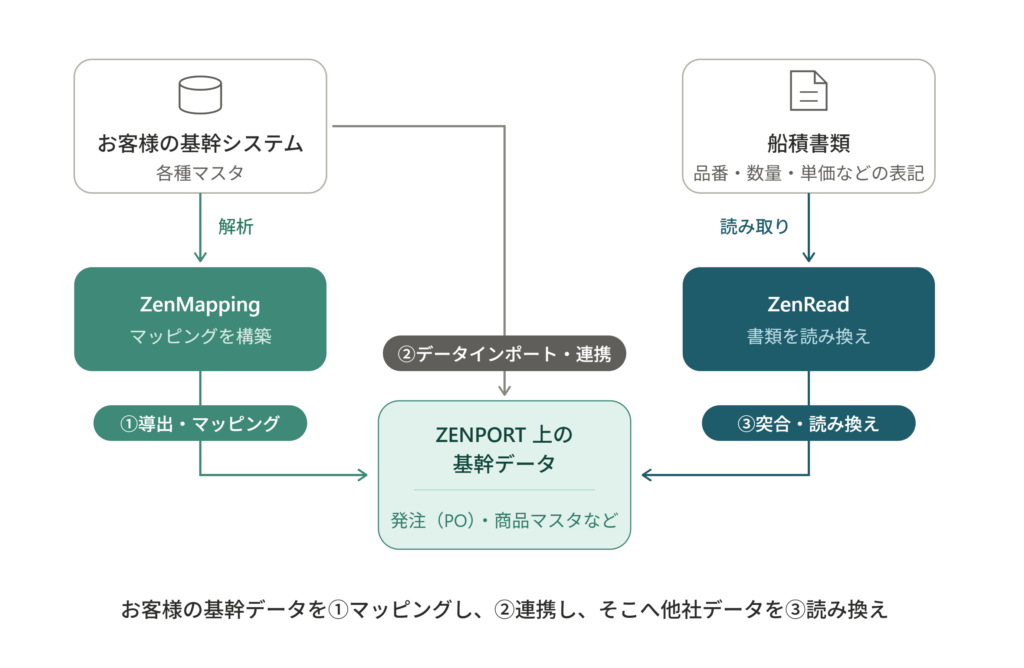
ZenMapping analyzes the master data structure of the customer’s ERP system, derives the mappings, and links them (Figure 1). Through these mappings, ZENPORT syncs the customer’s ERP data, such as purchase orders (POs) and the item master (Figure 2).
ZenRead is the AI agent that translates shipping documents into ERP data. It matches what it reads against contextual data—the ERP data held in ZENPORT—and translates the descriptions on each document into the customer’s items and the matching lines of its purchase orders (Figure 3). (See the August 10, 2026 release on this enhancement: [link to the English ZenRead release].)
With this overhaul, accurate mappings are derived in far less time, supporting ZenRead’s translation work.
■ How People and AI Share the Work
In the overhauled ZenMapping, people go only as far as approving the meaning; AI handles the implementation of the mappings. The authority to decide what counts as correct always stays with the customer, and AI adapts to that decision.
Customer data is not shared with other companies, and Zenport does not use it to train models. Mappings are kept separate for each customer, so one customer’s data never affects another’s results.
Guided by the principle of Human in the Loop, ZENPORT supports better operations and management through collaboration between technology and people.
■ Implementation
ZenMapping can be implemented on top of each trading partner’s existing workflows and document formats and the customer’s existing ERP systems. Because it works from data that already exists, it adds no new manual entry as a rule.
Data that customers enter or sync into the service, and the results it generates, are managed so that no other customer can view or use them. The service uses generative AI services under contracts and settings that prevent this data from being used to train or improve shared AI models. Zenport does not use this data to train models either, unless the customer explicitly consents or instructs otherwise.
■ Putting “Fit to Ontology” into Practice
This overhaul is a product implementation of “Fit to Ontology,” the approach ZENPORT proposes:
An approach that moves the target of standardization from the layer of operations and systems to the layer of meaning, and hands the role of fitting to the standard from humans to AI. Here, it is AI, not humans, that performs the Fit. The AI that fits, not the human.
For the definition, see https://zenport.io/fit-to-ontology/ (Japanese). The original article is also available in English: https://medium.com/@fumiyuki.ota/from-fit-to-standard-to-fit-to-ontology-ai-s-new-equilibrium-in-enterprise-tech-8d86ad3e02f5
■ About ZENPORT — A World Where Cognitive Diversity Creates Prosperity and Innovation
ZENPORT envisions a world where global data, people, and economies are seamlessly connected, enabling sustainable prosperity and innovation through cognitive diversity.
Under this vision, Zenport provides a data foundation that lets customers connect across organizations without asking their partners to change: ZenRead, which connects trade documents to operational data, and ZenMapping, which connects data to ERP systems and master data reproducibly and traceably.
■ Company Overview
・Company name: Zenport Inc.
・Address: GranTokyo South Tower 11F, 1-9-2 Marunouchi, Chiyoda-ku, Tokyo 100-6611, Japan
・Representative: Fumiyuki Ota, CEO
・Vision: “A world where differences become strengths.”
・Mission: “Connecting data across organizations and processes to accelerate business.”
・Business: Development and provision of an AI-native ontology platform for global supply chains. Proponent of “Fit to Ontology.”
・URL: https://zenport.io
■ Media Contact
Zenport Inc., Public Relations — info@zenport.io